

When you begin your journey to find the perfect wedding dress, one of the first surprises you might encounter is the sizing. Many brides are caught off guard when they find themselves wearing a wedding dress size that’s completely different from what they’re used to on the high street. Don’t worry—this is completely normal and nothing to stress about! It is also why purchasing off the peg can save you seamstress cost in the long run.

What size dress should I order?
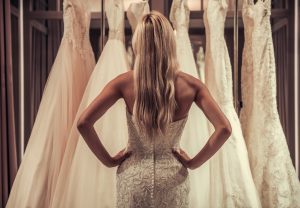
The most important advice is trust your wedding dress fitter and don’t worry too much about the number on the label. Bridal sizing can be very different from the high street, so the size you normally buy isn’t necessarily the size that will fit you best in a wedding dress.
If you’re ordering a gown, your fitter will take your measurements and recommend the most appropriate size – but remember that when your dress arrives, it will almost certainly still need some work from a seamstress to make it fit you perfectly, so allow for that additional cost in your wedding dress budget. If you’re buying off the peg, it’s much simpler: there is nothing to order and no months of waiting for your dress to arrive.
The dress you try on is the actual dress you take home. What matters isn’t whether the label says 10, 12, 14, 16 or 18; it’s whether that particular dress fits your body and makes you feel wonderful. A good bridal boutique will help you find the right fit – whatever the number happens to say.
Why Are Wedding Dress Sizes So Different?
Wedding dress sizes don’t follow the same sizing standards as high street (or ready-to-wear) clothing. In fact, most bridal designers use their own unique size charts, and many still base their measurements on vintage sizing from decades ago. This means:
- A bride who normally wears a UK size 10 on the high street may find themselves wearing a bridal size 12, 14, or even higher depending on the designer.
- Bridal sizes are more about measurements than your “usual” number, so the focus is on bust, waist, and hip dimensions rather than standardized labels.
View all our dresses, categorised by size.
Remember, search around your High Street size when browsing. Frequently we find a dress that isn’t the size the bride to be thought she was. So it is important not to ‘write off’ a dress you love based on the size alone. If might fit you! Consider the size a ‘guide’ only!


It’s not uncommon for brides to feel disheartened when they try on a dress in a size or two larger than they expected—but trust us, the number is just a guideline, not a reflection of your body or beauty.


Wedding Dress Sizes FAQs
Are Wedding Dress Sizes the Same as Normal UK Sizes?
Not necessarily. Your normal UK high street dress size is useful as a starting point, but it shouldn’t be treated as your definitive wedding dress size.
Wedding dress designers generally work to their own size charts, using measurements such as your bust, waist and hips. This means the measurements one designer describes as a bridal size 12 could be labelled a 14 by another designer.
Even high street sizing varies between brands, so it’s better to think of the number inside a wedding dress as a guide to its measurements rather than a judgement about what “size” you are.
Your wedding dress size and your normal dress size don’t have to match – and that’s perfectly normal.

Do Wedding Dresses Come Up Small?
It’s common to hear brides say that wedding dresses “come up small” because they find themselves trying a higher number than they normally buy on the high street.
A better way of looking at it is that bridal sizing is different.
Wedding dresses can also be much more structured than everyday clothing. Boning, corsetry, fitted bodices, multiple layers of fabric and fabrics with very little stretch can all affect how a gown fits.
The silhouette matters too. A fitted crepe or mermaid wedding dress can feel completely different from a flowing A-line gown, even when both dresses carry exactly the same size label.
So don’t walk into a bridal shop thinking, “I’m a size 12, therefore I need a size 12 wedding dress.”
Start with the dress. Then find the one that fits.
What Wedding Dress Size Am I?
There isn’t one wedding dress size that you will necessarily be across every designer.
If you’re ordering a new wedding dress, your bridal fitter will usually take measurements including your bust, waist and hips and compare them with the individual designer’s size chart. Your recommended size will be based on those measurements rather than simply ordering your usual high street size.

And even when a gown is ordered in the recommended size, alterations are very common. Wedding dresses are produced to standard measurements; your body isn’t.
At From Above, shopping works slightly differently because our wedding dresses are available off the peg.
That means you can try the actual wedding dress that’s available rather than trying a boutique sample which will subsequently be used to order another gown. The dress you fall in love with is the dress you can take home.
That makes the fit of the actual gown far more important than the number printed on its label.
Why Can Two Wedding Dresses in the Same Size Fit Differently?
You could try two size 14 wedding dresses and discover that one fits beautifully while the other feels completely different.
That’s because size is only one part of fit.
Different designers use different measurements, while the cut and construction of the dress also matter. A corseted bodice behaves differently from an unstructured bodice. A fitted skirt places more emphasis on hip measurements than a flowing A-line skirt. Fabrics containing some stretch behave differently from heavily structured fabrics.

Bust shape, waist position, neckline, boning, seams and the overall silhouette can all change how a dress sits on your body.
So if one wedding dress in “your size” doesn’t fit, don’t assume every other dress carrying that number won’t fit either.
Try the dress.
Should I Buy a Wedding Dress in a Bigger Size?
If you’re ordering a wedding dress, your bridal fitter should recommend the appropriate size using the designer’s measurements rather than simply guessing from your normal clothing size.
It’s also quite normal for an ordered wedding dress to need alterations afterwards. A standard-size gown has been made to a size chart, not specifically to your individual proportions.
For example, your bust might correspond most closely with one size while your waist or hips correspond with another. A fitter may therefore recommend a size that accommodates the measurement that is most important for that particular gown, with a seamstress refining the fit afterwards.
If you’re buying off the peg, the question becomes much simpler:
Does this particular dress fit you well, and can any necessary alterations be made successfully?
At From Above, you’re trying the actual gown that’s for sale, so you can make that decision with the dress physically on you.
Wedding Dress Size vs Street Size – What Really Matters?
If you’ve searched for a wedding dress size vs street size conversion, it’s worth remembering that there isn’t a universal conversion that works for every bridal designer.

A chart suggesting that a high street size 10 always equals a particular bridal size can only ever be a rough guide.
Designer sizing varies, dress construction varies and women’s proportions vary.
That’s why we recommend using your usual UK dress size as a starting point rather than a rule.
The goal isn’t to find a wedding dress with the “right” number sewn into it.
The goal is to find the wedding dress that feels right when you’re wearing it.
Shop Wedding Dresses by Size
Now you know why wedding dress sizes can differ from your normal high street size, you can explore the dresses we currently have available at From Above.
Don’t worry about choosing just one category. Because designers and styles fit differently, it’s worth looking at the size category around your usual size as well as those immediately above and below it.
Every dress you see is part of our current collection at From Above in Elland, West Yorkshire. Our collection includes new, sample, ex-display and pre-loved designer wedding dresses – all available without the traditional wait for a new gown to be ordered.
Don’t Let the Number Choose Your Wedding Dress
Wedding dress shopping should be about discovering how you feel in a gown, not worrying about the number hidden inside it.
Come with an open mind. Try different designers, silhouettes and sizes. Listen to the advice of your fitter and pay attention to the dress that makes you want to look in the mirror again.
If you’re ordering a gown, expect your fitter to recommend a size from the designer’s measurements and remember that alterations may still be needed afterwards.
If you’re shopping off the peg at From Above, you have an even simpler advantage:
you can try the actual dress, see how it fits and decide whether it’s the one.
Because ultimately, nobody at your wedding is going to ask what size your dress was.
They’re going to see you in it.
Common Differences Between Bridal and High Street Sizes
Keep in mind: bridal gowns are usually made to standard sizes, not custom to your body (unless you’re going couture). Alterations are a standard part of the process to get the perfect fit. But if you buy a sample dress, frequently these may fit perfectly and are available to take away without alteration.

Variations Between Designers
One of the trickiest aspects of bridal sizing is that each designer has their own size chart. That means you could be a bridal 10 in one label and a 14 in another—without changing a single thing about your body. Some key points to keep in mind:
- European designers (like Pronovias, Rosa Clará, or Jesus Peiro) tend to run smaller than UK sizes.
- American designers (like Maggie Sottero, Justin Alexander, or Morilee) often use a different sizing scale altogether—sometimes more forgiving than European ones.
- British designers (such as Jenny Packham or Sassi Holford) may align more closely with UK high street sizing but still typically size up.
Because of this, it’s important not to get too hung up on the size tag. Instead, focus on how the dress feels, how it fits your body, and how it makes you feel when you look in the mirror.
Tips for Brides Shopping for Their Dress
- Be open-minded about sizing. Try not to fixate on the number—it’s not a reflection of you, just a system that varies wildly.
- Trust your bridal consultant. They’ve worked with all shapes and sizes and will guide you toward styles (and sizes) that will flatter your body.
- Plan for alterations. Almost every bride will need some tailoring to get a perfect fit. Consider this part of the process, not a problem.
- Don’t compare designers. Sizing will shift from one label to another, and that’s okay. Focus on the gown you love—not the number on the tag.
We’re here to help
Bridal sizing can be confusing and sometimes even frustrating, but it’s important to remember that it’s just a number. The perfect wedding dress is the one that makes you feel incredible—regardless of size. So when you step into the boutique, go in with confidence, trust the process, and remember: it’s not about the label, it’s about you. And remember, pre-loved dresses rarely need altering and may save you not only on the initial price, but in adaptions too.
Contact us

